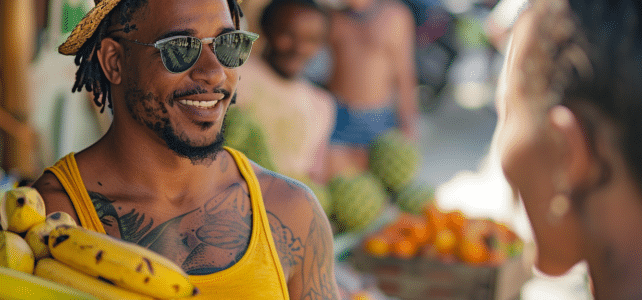
Caribbean patois, rich in colors and expressions, reflects a complex history blending diverse cultures and influences. Some of its expressions bear the scars of tumultuous periods, notably colonization and slavery, and can be sources of controversy. The use of these linguistic turns provokes a debate between the desire to preserve cultural heritage and the necessity to adapt to contemporary norms of respect and inclusion. This dialogue is part of a broader dynamic of reconciliation with the past and social evolution within Caribbean communities.
The cultural and social impact of controversial expressions in Caribbean patois
Caribbean patois, a living and evolving language, is at the heart of unique cultural and social dynamics. The controversial expressions that pepper this dialect have significant consequences on the social fabric of the affected islands. Caught in the tumult of regional history, they embody both a heritage and a challenge for local populations. Creoleness, a central concept in understanding Caribbean linguistic diversity, is tested by these turns that can offend or marginalize.
Linguists like Jean Bernabé and Marie-Christine Hazaël-Massieux agree on the complexity of these expressions, which draw from a vocabulary often rooted in French lexicon. The Creole expression, in particular, is tinged with French but also English, reflecting an ongoing cultural mix. Should we then see the insults in Creole as merely a cultural heritage or as an expression of a social reality that is constantly changing?
Creole literature, especially that produced in Martinique and Haiti, provides a platform for these words laden with history. It also contributes to the evolution of the language by questioning and sometimes overturning the connotations of certain expressions. Caribbean authors play a significant role in the deconstruction of prejudices and the promotion of a rich and diverse Creole identity. Therefore, the controversial expressions of Caribbean patois must be approached with a keen awareness of their cultural and social impact. They reveal the tensions between collective memory and current issues of inclusion and mutual respect. In this light, Creole language, far from being a mere means of communication, serves as a mirror of Caribbean societies, revealing both their fractures and their aspirations for unity.
The challenges of preserving Caribbean patois in the face of controversy
The preservation of Caribbean patois, rich in multiple influences and a vector of remarkable linguistic diversity, faces notable linguistic challenges. The controversy surrounding certain expressions, sometimes deemed archaic or offensive, raises the question of their maintenance or evolution. Linguists and cultural activists question the balance to be found between preserving a linguistic heritage and the need to promote a language that reflects the values of an inclusive and respectful society. The debate is similar to that surrounding Vendéen patois in France, where efforts are made to keep Vendéen customs and traditions alive.
Cultural initiatives such as those led by Autrefois Challans or by artists like Yannick Jaulin and Chapuz work towards the preservation of these regional dialects. These cultural actors focus on valuing Vendéen patois, not only as a means of communication but also as a key element of regional identity. Similarly, in the Caribbean sphere, cultural events, radio shows, and publications in Creole contribute to strengthening the legitimacy and visibility of patois in the face of the challenges posed by controversial expressions.
The French Republic, whose official language is French, strives to recognize and protect the diversity of its regional languages while ensuring the unity of the national language. This policy is reflected in overseas territories like Guadeloupe, where Creole, although the mother tongue of the majority, sometimes finds itself in tension with standard French. Creoleness, despite being a richness, confronts the linguistic norm of the French colonial empire, thus generating a field of tensions between preservation and integration within the Republic.