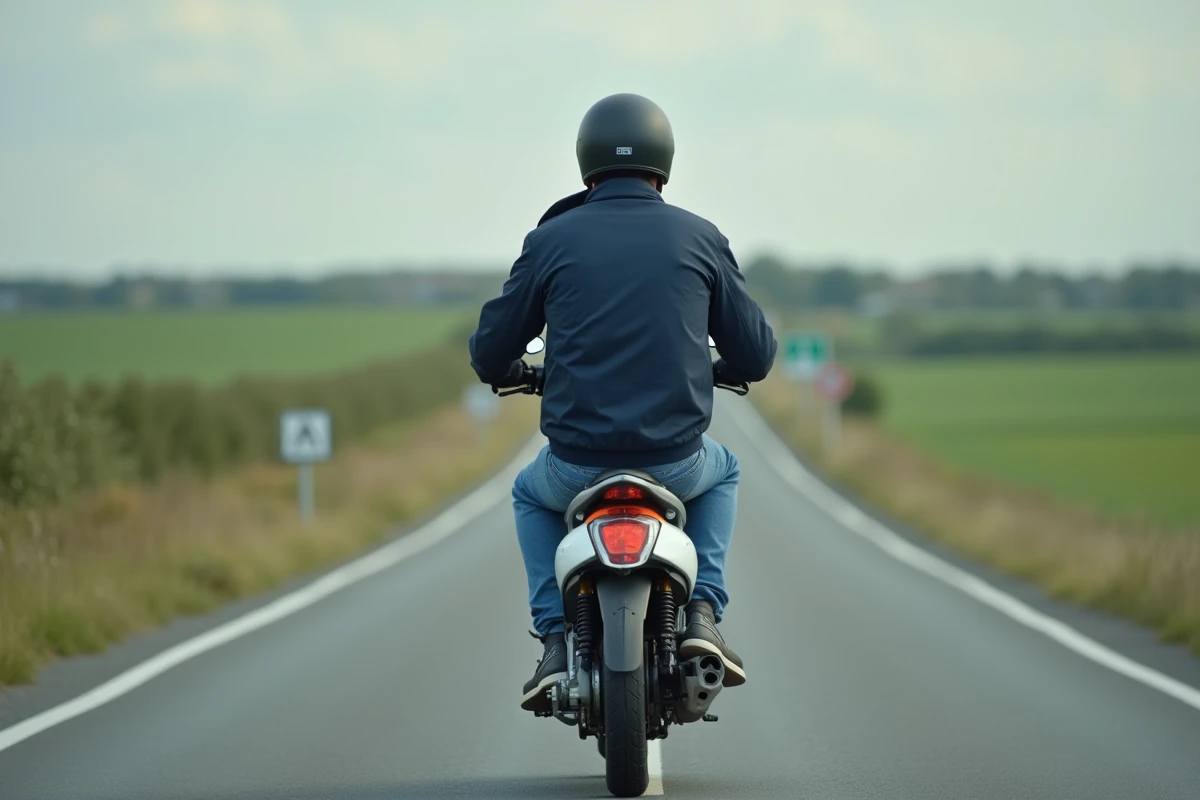
50cc scooters are prohibited on the highway, but their presence on national roads regularly raises concerns for law enforcement. The regulations clearly distinguish between different categories of roads, without always eliminating ambiguity for drivers.
On the asphalt of national roads, the status of the 50 cm³ scooter continues to be debated. Some sections allow them access, while others block their entry without hesitation. With each change of sign, the risk of infringement looms, waiting for the slightest lapse in knowledge or attention. Understanding the logic that governs these accesses is key to avoiding penalties and driving without fear of checks.
Riding a 50cc scooter on national roads: what the legislation provides
The circulation of 50 cm³ scooters on national roads is not improvised. The law relies on several reference texts: the highway code, decree n°2002-675 of April 30, 2002, as well as the order of November 8, 2012. Officially considered a moped, the 50cc must meet a series of conditions before venturing outside urban areas.
To ride a scooter on national roads, one must hold the AM license, the modernized version of the BSR, in effect since 2013. This license, available from the age of 14 for those born after January 1, 1988, is obtained after eight hours of training combining theory and practice. One must also present a school road safety certificate (ASSR) or its equivalent, the ASR. Those over 36 years old (born before December 31, 1987) are exempt from the license requirement, provided they have a registration certificate and are covered by liability insurance.
The moped, for its part, must meet strict criteria: engine capacity not exceeding 50 cm³, power limited to 4 kW, and a maximum speed capped at 45 km/h. There’s no escaping it: wearing an approved helmet and compliant equipment is required from the very first kilometer. Law enforcement can check the validity of the vehicle’s documents (registration, insurance) at any time.
Driving a 50 cm³ scooter on national roads means perfectly aligning training, technical compliance, and insurance coverage. For those wishing to delve deeper, the page “Scooter: Can it circulate on a departmental road? – Auto Maniacs” provides additional insights.
National roads, highways, expressways: what limits should be known?
In terms of mobility, the boundary between national roads, highways, and expressways allows for no approximation. The rules differ depending on the type of roadway, and the moped is not welcome everywhere.
Here’s a precise overview of the allowed and prohibited accesses for 50cc scooters:
- Highways are strictly prohibited for them, without any exceptions.
- Expressways, often indicated by a blue sign, also close their doors to them, just like the Paris ring road, regardless of the speed limit.
Access remains possible only on classic national roads, meaning those that have not been reclassified as expressways or highways. But caution is essential: with a speed capped at 45 km/h, the scooter driver must remain extremely vigilant in the face of the flow of cars and trucks. The slightest lapse can lead to an unpleasant surprise.
Bicycle paths represent a special case. Some municipalities allow mopeds on these paths, but this decision belongs exclusively to the town hall through a municipal order. Before venturing onto them, it is advisable to check the signage on-site and inquire locally.

License, equipment, insurance: essential obligations for legal circulation
Riding a 50 cm³ scooter on national roads means accepting a whole set of obligations. During a check, the driver must present each required document: AM or BSR license, registration certificate, liability insurance certificate. Forgetting any of them can be costly: up to €38 fine on the spot, and €135 if the registration certificate is missing.
Driving without an AM license is not merely an administrative oversight. For those born after January 1, 1988, the absence of training (minimum 8 hours with the ASSR or ASR) exposes them to particularly severe penalties: up to one year in prison, €15,000 fine, community service, or even confiscation of the scooter. Point deductions do not exist for this type of vehicle, but fines are still on the table, without leniency.
Insurance, for its part, tolerates no oversights. Driving without insurance exposes one to a fine of up to €3,750, suspension of the right to drive, or even immobilization of the two-wheeler. Liability insurance must be obtained before the first use of the scooter.
Wearing an approved helmet and CE-certified gloves is not merely a recommendation. It is a legal obligation, again accompanied by penalties in case of non-compliance, including a fine and, sometimes, the immobilization of the vehicle.
On national roads, the 50 cm³ scooter has no room for error. Every detail counts, every document matters, every protective gesture is important. Ride light, yes, but never carelessly.