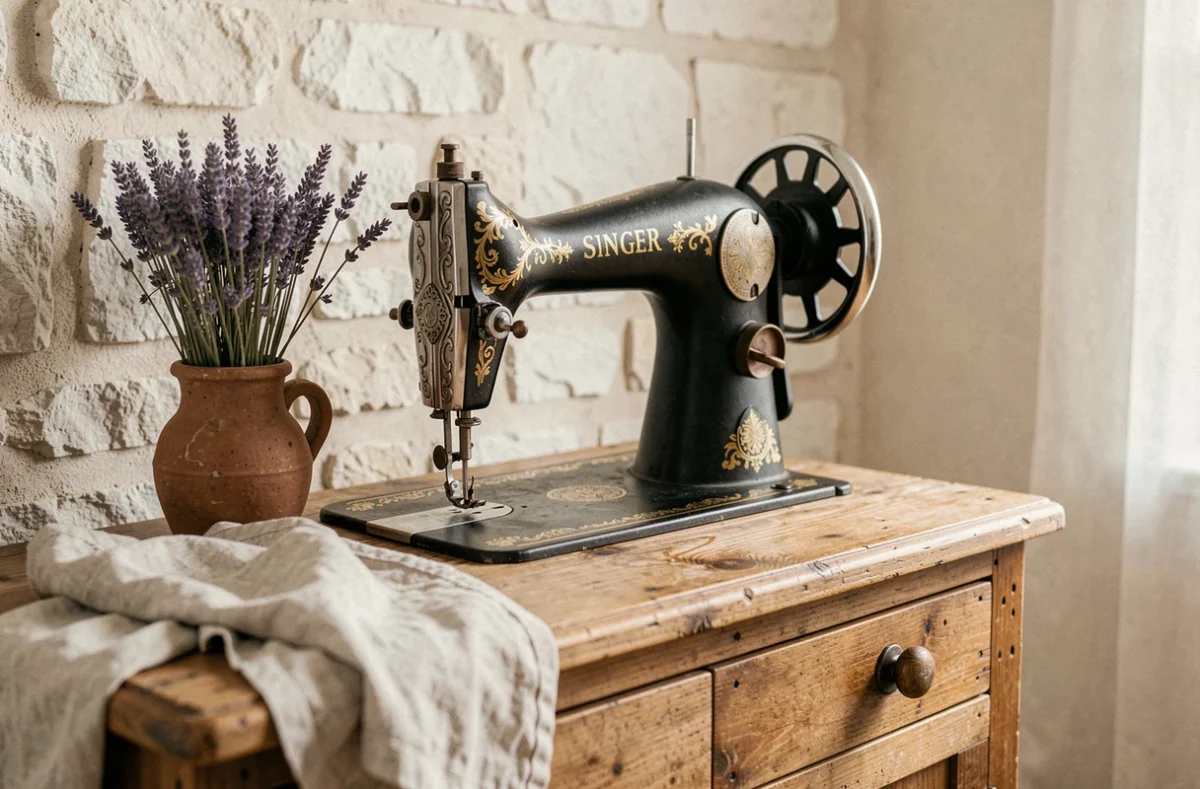
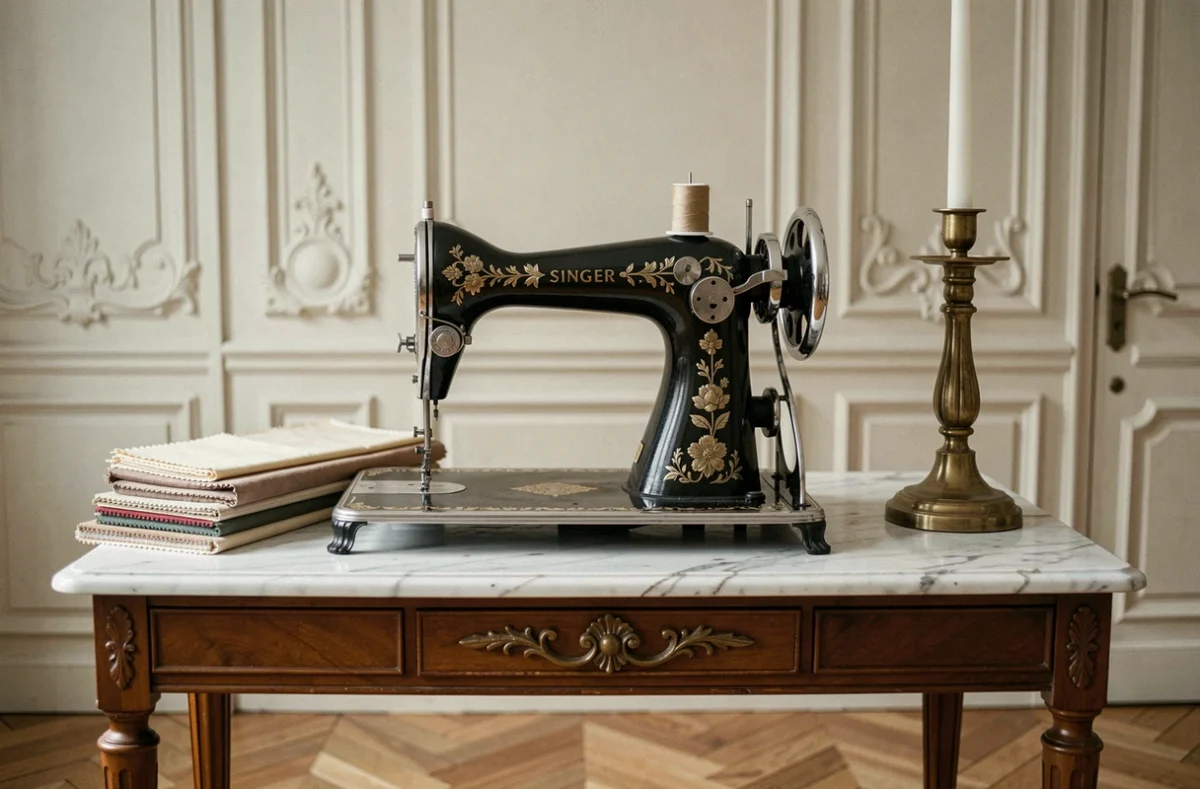
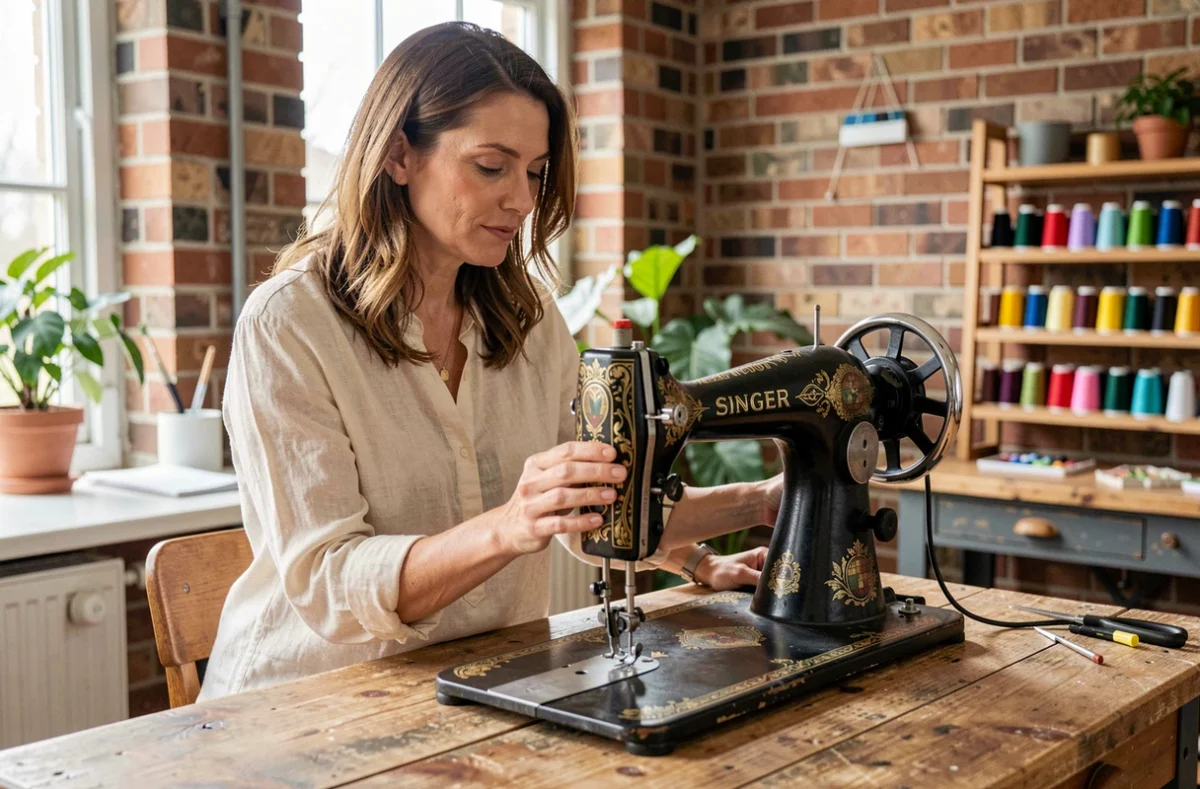
A Singer sewing machine referred to as “decorative” designates a compact mechanical model, designed to create ornamental stitches in addition to utility seams. Its use is not limited to fabric assembly: it allows for the production of custom textile elements intended to dress an interior, from cushion covers to lined curtains.
Decorative stitches and upholstery fabric: what a mechanical machine allows
There is often confusion between “decorative machine” in the aesthetic sense (a beautiful object placed on a piece of furniture) and “decorative stitch machine” in the functional sense. The Singer Decorative belongs to the latter category. Its stitch programs, which combine straight seams, zigzag, and ornamental patterns, serve to customize each textile piece produced.
Specifically, decorative stitches transform a plain hem into a visible finish, a tablecloth edge into a graphic detail. On a cushion or curtain, a fancy stitch replaces a long and tedious manual embroidery. This is what distinguishes this approach from simple garment alteration.
Choosing a Singer decorative sewing machine thus means investing in a tool oriented towards textile creation for the home, not just for clothing repair. The compact format of this type of machine also allows for easy storage between projects, without monopolizing a desk or a permanent workspace.
Custom sewing for the interior: cushions, curtains, and unique pieces
Decorative sewing projects are gaining ground in creative workshops. Making your own cushions, curtains, or placemats offers a direct advantage: each piece adapts to the exact dimensions of your space. A custom curtain fits the height of an atypical window. A homemade cushion matches the fabric of a sofa without compromising on color.
The Singer Decorative, as a mechanical machine with multiple programs, covers most of these needs. The adjustable stitches allow for working with common upholstery fabrics (thick cotton, linen, canvas) with sufficient consistency for a clean finish.
Adapting the fabric to the character of each room
A living room calls for different materials than a bedroom. Raw linen brings character to a living space, while washed cotton is better suited for an intimate room. The machine allows for switching from one fabric to another by adjusting the thread tension and stitch length, without changing equipment.
This versatility avoids the need to accumulate multiple devices. A single well-adjusted mechanical machine replaces ready-to-use textile purchases that are often generic and rarely the right dimensions.
Textile upcycling: transforming the existing rather than buying new
Recent sewing trends highlight the reuse of existing textiles. Old sheets, outdated shirts, fabric scraps: these materials become the basis for decorative projects when you have a reliable sewing machine.
- A worn jean transforms into a thick, durable cushion cover with a raw character suitable for an industrial or bohemian interior
- Scraps of linen or cotton, assembled in patchwork, produce a unique table runner that won’t be found in any catalog
- An overly long curtain for an old window is recut to new dimensions, with a decorative hem that conceals the alteration
Textile upcycling gives a second life to materials that have already been amortized, while reducing purchases of standardized decoration. The Singer Decorative, thanks to its ability to work with multiple layers, is well-suited for this type of project where recycled fabrics vary in density.
Repairability and lifespan: a criterion often overlooked before purchase
Before choosing a sewing machine for regular decoration projects, the question of repairability deserves attention. A mechanical machine like the Singer Decorative has a structural advantage in this regard: less electronics means fewer complex breakdowns.
The availability of spare parts and access to after-sales service remain decisive criteria. In France, the legal warranty of conformity covers repair or replacement in case of breakdown within two years of receiving the product. This framework protects the buyer but does not exempt one from checking in advance if the Singer repair network covers your geographical area.
Routine maintenance of a mechanical machine
A machine intended for working with upholstery fabrics accumulates more dust and fibers than a machine reserved for lightweight textiles. Cleaning the bobbin compartment, regularly lubricating moving parts, and changing the needle according to the fabric are the three actions that prolong the device’s lifespan.
- Clean the bobbin case after each project involving raw linen or cotton, which generate a lot of lint
- Use a needle of the appropriate gauge: a needle that is too fine on thick fabric strains the mechanism and prematurely wears out internal parts
- Oil the friction points according to the manual’s instructions, usually every few hours of intensive use
These simple actions prevent most mechanical breakdowns. Regular maintenance costs less than a repair in a workshop, and preserves the precision of decorative stitches over the long term.
Singer machine and workspace: integrating sewing into an office or living room
The compact format of the Singer Decorative facilitates its integration into an interior without a dedicated sewing room. Placed on a desk, side table, or low furniture, it occupies a space comparable to that of a home printer.
For decoration projects, a stable work surface is sufficient. The machine does not require a specialized sewing table, making it accessible to those who sew in their living room or bedroom. Between projects, it can be easily stored in a closet.
This practicality of use partly explains the appeal of this type of machine for interior decoration. Sewing becomes a tool for furnishing, not a hobby that requires an entire room. A cushion can be sewn in one evening, a curtain hem in less than an hour, and the machine can be put away as soon as the project is finished.